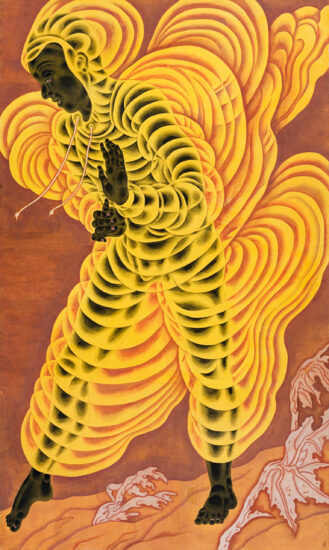
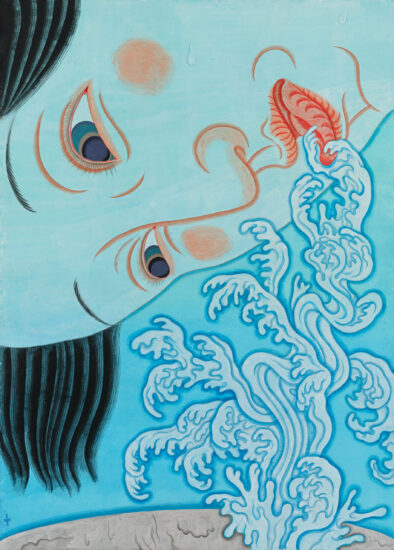
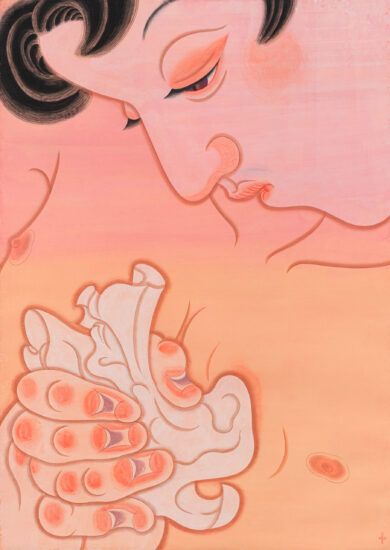
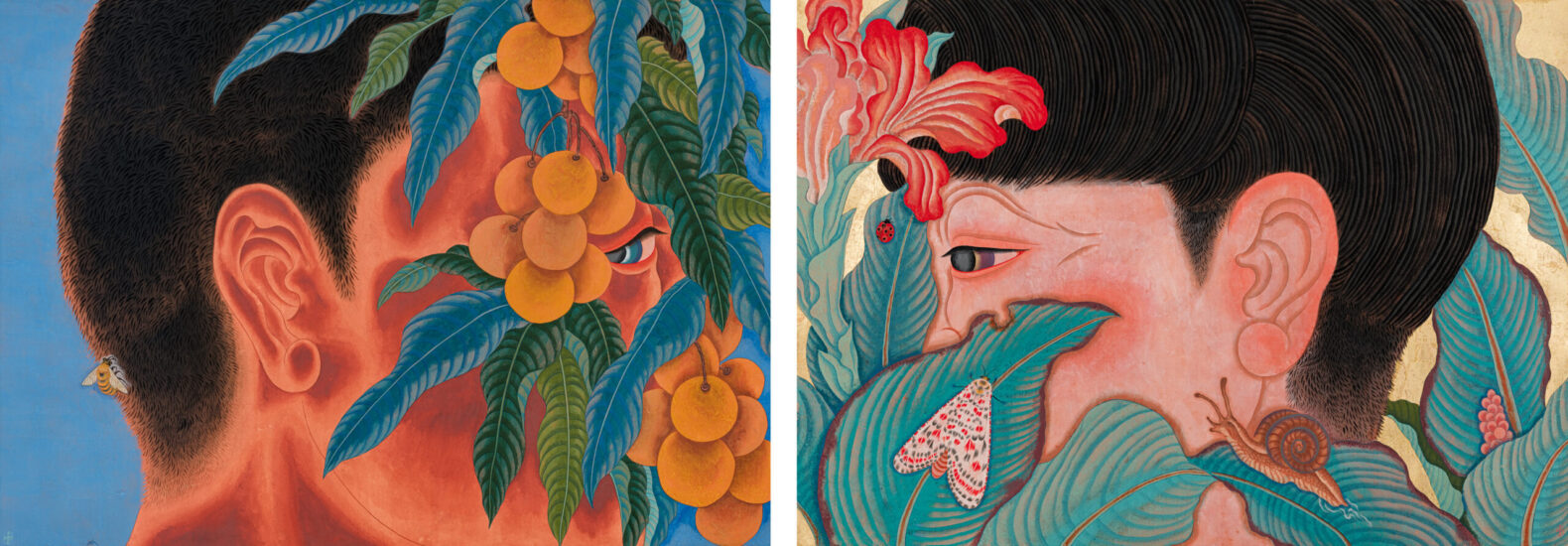
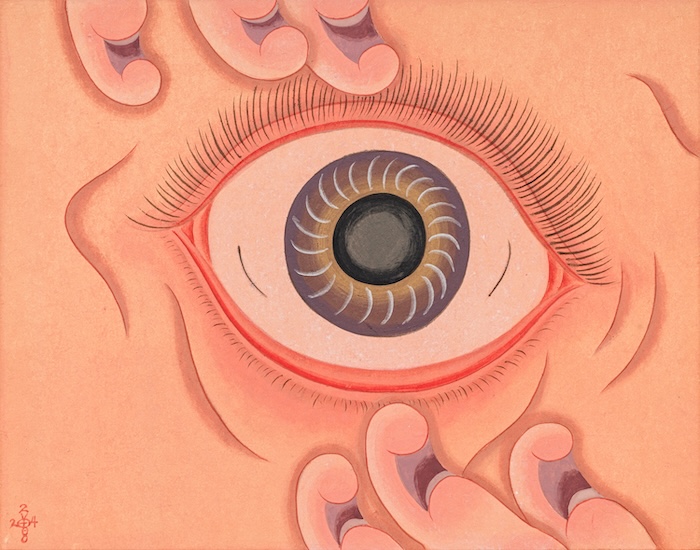
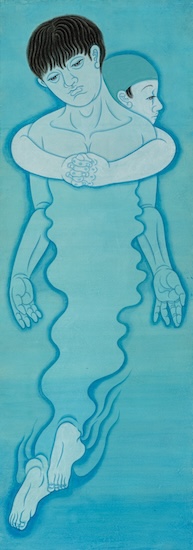
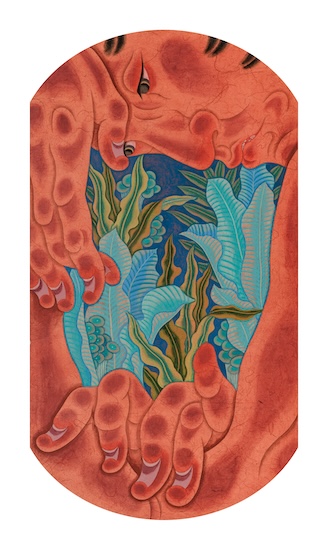
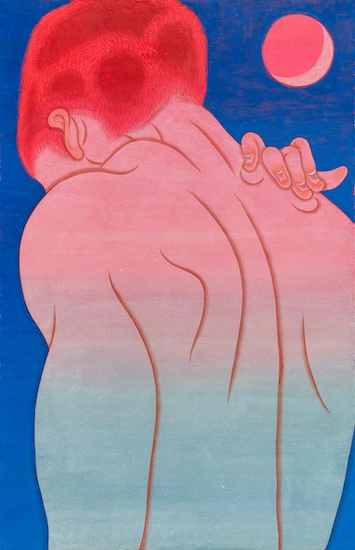
Working primarily with ink, gouache, and ceramic sculpture, Tseng Chien-Ying (b. 1987, Taiwan) draws upon traditional East Asian materials and aesthetics to articulate contemporary conditions of embodiment, spirituality, and socio-cultural tension. He blends various historic art techniques from Asia to render contemporary subjects within an ancient visual language.
Central to his practice is the exploration of religious iconography and religious visual experience to interrogate normativity. Often, he mines a ‘latent queer sensibility’ in the religious canon, splicing highly personal subjects and the iconography of Buddhist art to imbue his characters with solemn, dignified, and meditative expressions, in an array of psychedelic colours to create a strange, disharmonious atmosphere. Tseng’s figures occupy the compositions by discovering an eerily spiritual dimension of contemporary life, revealing ambiguous emotions through their faces, eyes, expressions, hands, feet, and, most prominently, skins.
Recently, the artist has been delving deeper into marginal narratives within popular culture: folk beliefs, historical iconographies and pop-culture. Reassembling these fragmented materials, it provides the artist an alternative lens through which to critique dominant art historical narratives. Tseng approaches tradition from a personal, bodily and often intimate, or ironically humorous perspective, and how notions of trauma, gender and morals are encoded within visual traditions.
Tseng graduated in 2009 with a BFA from National Taiwan Normal University and in 2013 with an MFA from Taipei National University of the Arts. Tseng held a major solo institutional exhibition at the Longlati Foundation, Shanghai, China in 2025 and his work has been exhibited at the National Taiwan Museum of Fine Arts, Taiwan (2020, 2017, 2015), Kaohsiung Museum of Fine Arts, Taiwan (2014, 2009), Taipei National University of Art, Taiwan (2013, 2011), and the Tunghai University Art Gallery, Taiwan (2011). His works are included in the permanent collections of National Taiwan Normal University; the National Taiwan Museum of Fine Arts (Taiwan); and the White Rabbit Collection (Australia).