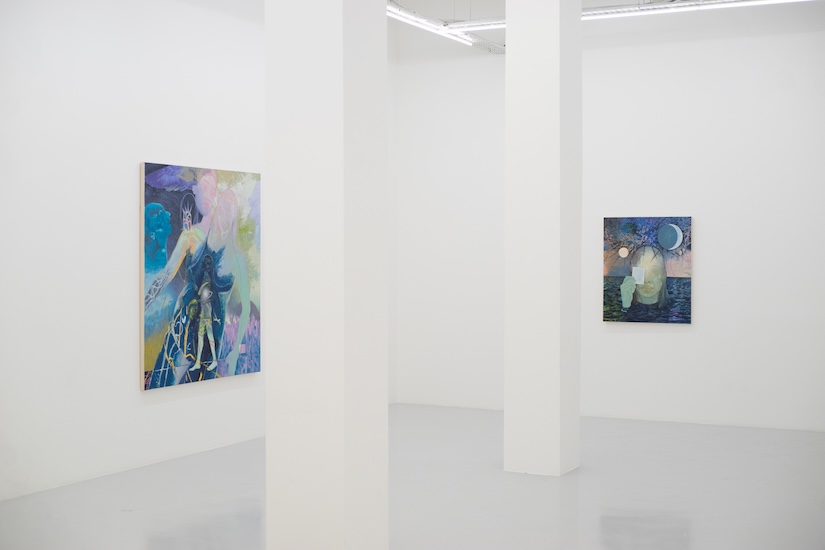


Ames Yavuz Singapore is pleased to present What Binds Me to This Land, a group exhibition featuring Srijon Chowdhury, Cian Dayrit, Tada Hengsapkul, Natalie Sasi Organ, and Nadia Waheed.
A conversation about land, territories, language, and the multivalent possibilities of all that is natural and imagined, What Binds Me to This Land brings together a diverse group of international artists that possess a distinct desire to recreate visual tableaus that allude to their personal and historico-political encounters with the natural world. Operating within systems of structured power, memory and legacies, these precepts often inform their modes of artmaking and storytelling. Through embedded stories of migration, colonisation, extraction and spirituality, these artists shape and reclaim narratives from landscapes of their collective past, present and future.
US-based Srijon Chowdhury (b. 1987, Bangladesh), Nadia Waheed (b.1992, Saudi Arabia), and Thailand-based Natalie Sasi Organ (b. 1999) present new paintings that speak of their connection with place, belonging and cultural memory.
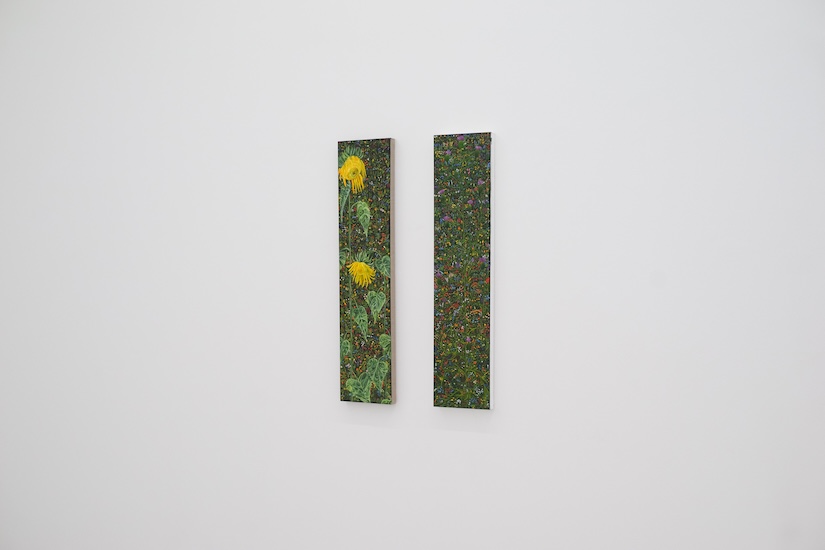
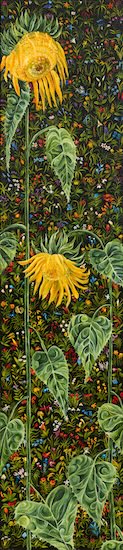
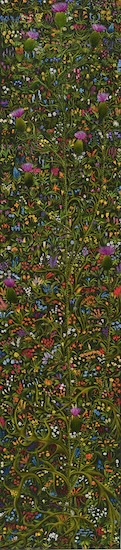
Oscillating between a highly stylized technique and uncanny realism, Srijon Chowdhury crafts spellbinding compositions that tap elements from daily life to find the universal in the quotidian. With a propensity for saturated hues, his immersive dreamscapes are planes where the boundaries between our physical reality and the supernatural dissolve. Chowdhury’s expansive interests in philosophy, religion, ecology, and art history reflect in the charged nature of his works that draw a constellation between the artist’s immediate environment and the spiritual, metaphysical, and mythological. Chowdhury presents two works, Two Sunflowers and Thistle in the exhibition, inspired by the artist’s personal interest in flora. Rendering these commonly found plants with a degree of veneration, Chowdhury draws on his daily experience with the natural world and art legacies to create delicate and hypnotic works that capture the microcosm of the universe — of temporality, transcendence, and unattainability of the mystical experience.
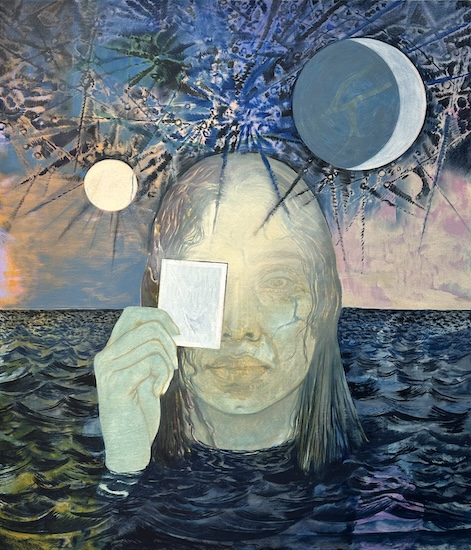
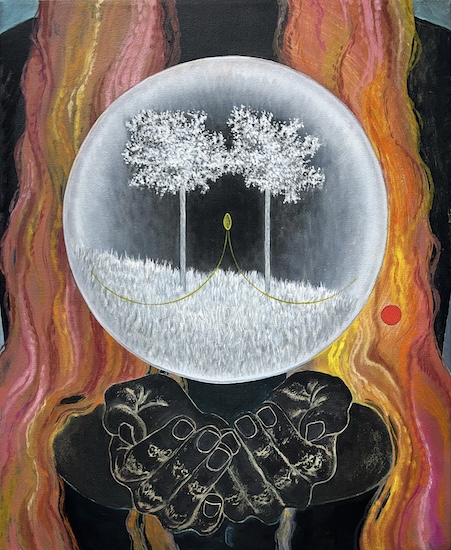
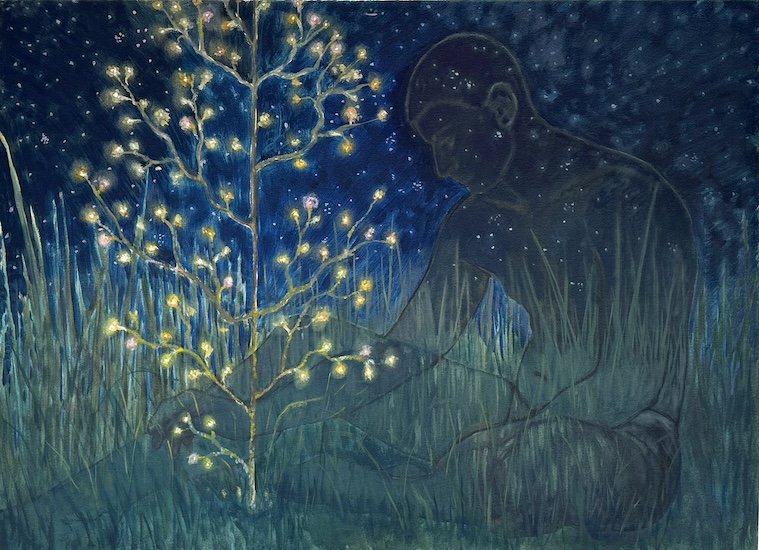
Pakistani-American artist Nadia Waheed creates allegorical paintings that unravel the connections between spirit and the corporeal form, the cyclical nature of life, and redemption. Autobiographical in nature, Waheed’s works draw from lived experience, science, philosophical archetypes and art history, with her new suite of textural paintings marking an evolution in her recent practice, both in process and content.
Hydra, August Twenty-Seventh, formula LP II, and The Last Poem reflect powerful ruminations on nurture and belonging, and complex emotional underpinnings of transformation and the future, informed by the artist’s recent journey into motherhood. Here the notion of place is intertwined directly with parenthood. Hydra and August Twenty-Seventh materially follow Waheed’s physical and spiritual metamorphosis — crafted over Waheed’s pregnancy, the works are composed of multiple layers of images and paint. Each change and layer is left visible in the finished piece, mirroring the way in which pregnancy has physically changed her own skin. formula LP II and The Last Poem contemplate the future and responsibility of parenthood. In these works, Waheed considers the lessons and values to impart onto her child so they will have a healthy sense of place and emotional openness to ground themselves amidst a harsher world. Flora is depicted firmly rooted in spaces and entangled between figure and landscape, weaving them into a single, breathing entity. In this body of new work, Waheed attempts to depict where the utter totality of love for her own child is spiritually and physically located.
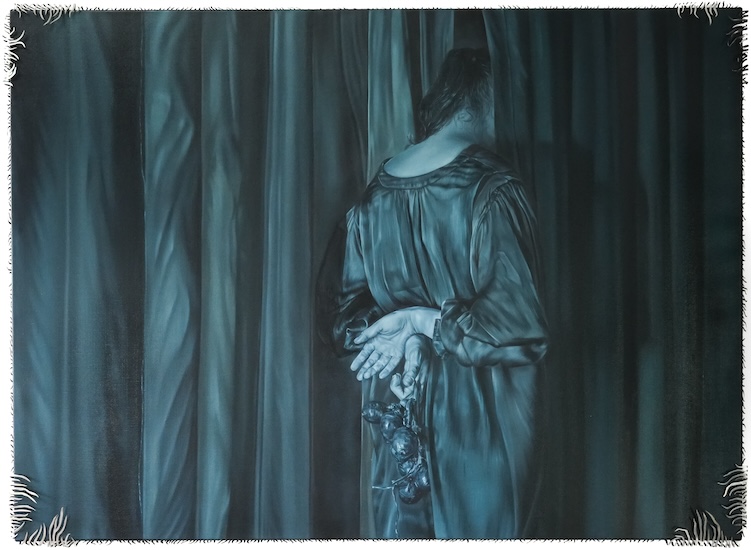
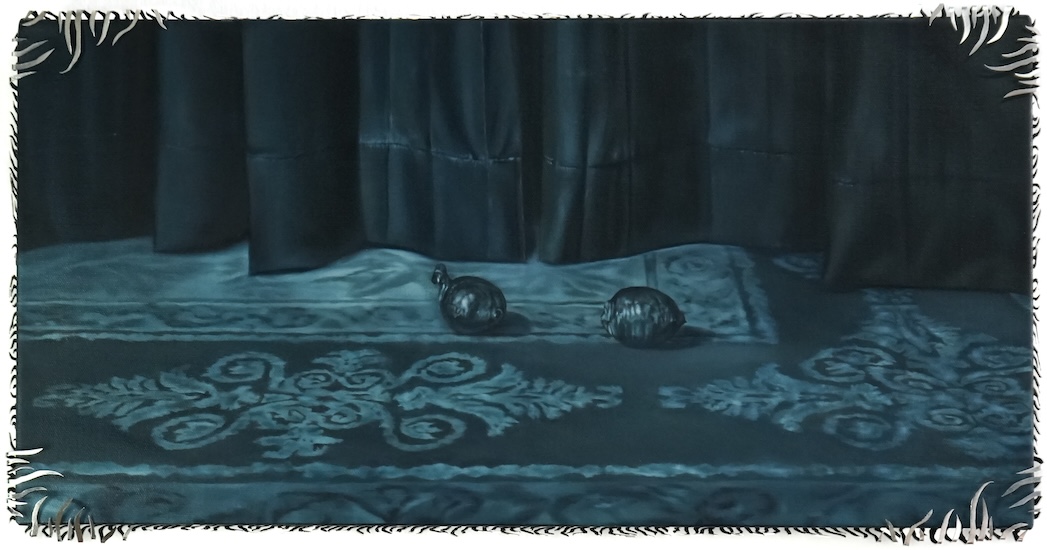
In Natalie Sasi Organ’s paintings, familial kinship and fractured traditions come to the forefront. She renders the moment of cultural slippage and the counter-gesture of retrieval with quiet precision. Slipping through the fingers shows betel nuts hanging from an outstretched hand, their descent not dramatic but almost imperceptible: a slow leak in the vessel of intergenerational knowledge. I knelt to gather depicts the aftermath — not of loss, but of response: the body lowered, the gaze redirected downward, as if hands poised to collect what the lineage failed to pass on. The works emerge from Sasi Organ’s dialogue with her grandmother, who ceased chewing betel decades ago under social and political pressure, and only now through the artist’s inquiry begins to share what was withheld. The betel nut, once central to rituals of womanhood, storytelling, and kinship, has been recast as obsolete or even criminal. Yet Sasi Organ treats its fall not as an endpoint, but as an invitation: to kneel, to look closely, to gather not just the object alone, but the silence around it. Together, they trace the arc from absence to action where the artist becomes both witness and weaver of a thread nearly broken.
Filipino-artist Cian Dayrit’s (b. 1989) and Thai-artist Tada Hengsapul’s (b. 1987) multi-media works speak of contested territories, and the historical and social boundaries we inherit.
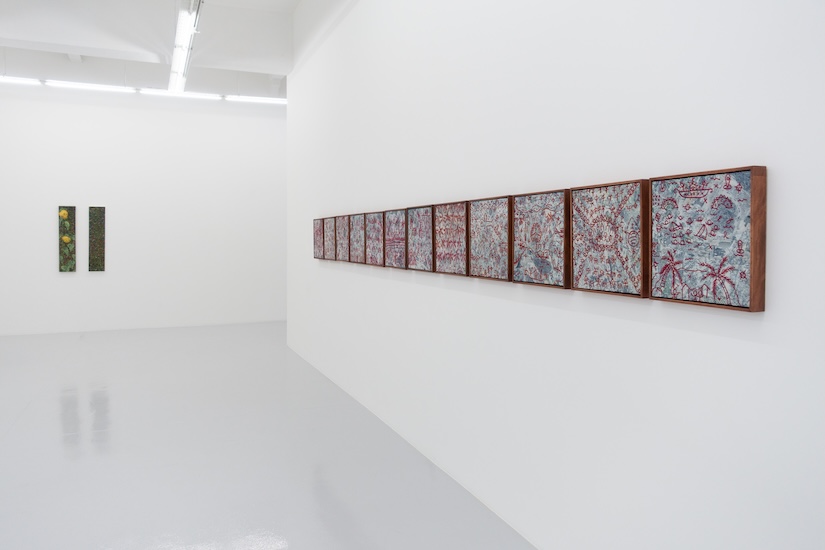
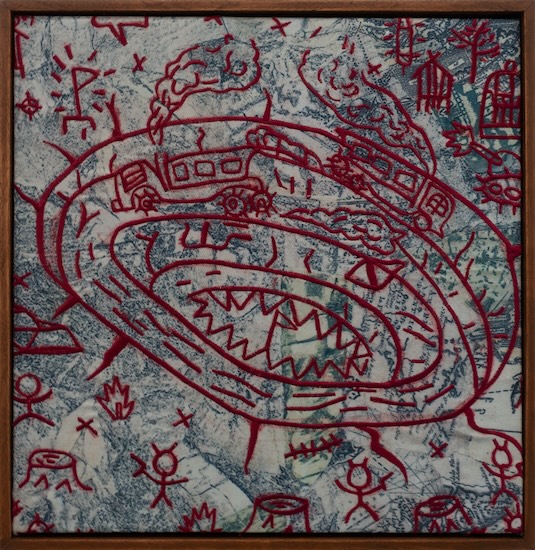
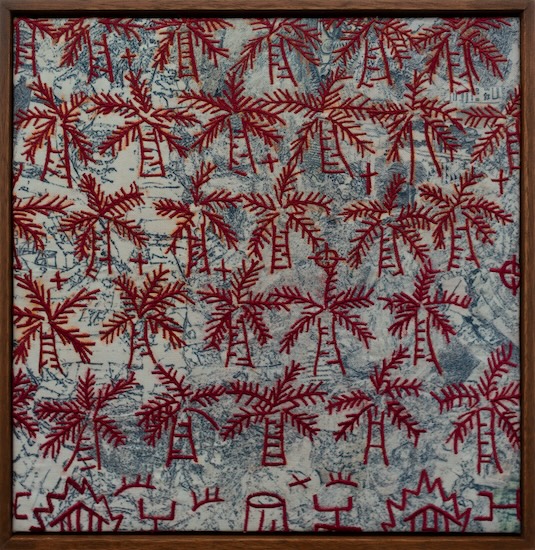
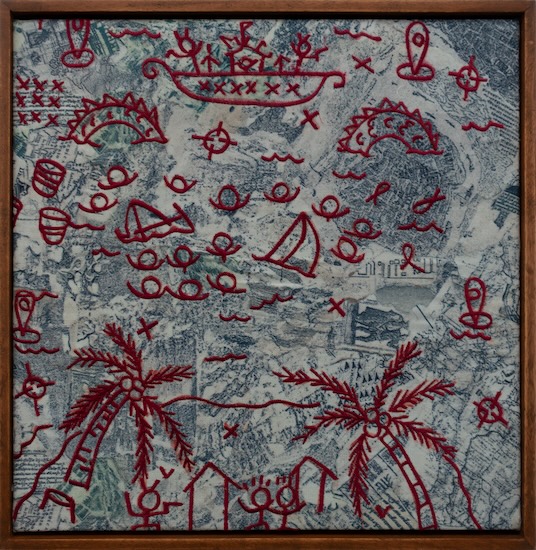
Working across textile and installation, Cian Dayrit investigates notions of power and identity as they are represented and reproduced in monuments, museums, maps and other institutionalised media. His work often responds to different marginalised communities, encouraging a critical reflection on colonial and privileged perspectives. Dayrit presents a new series of twelve works, titled INFRA (Intentional Negation of Foreign Resource Appraisals) that combine archival references and protest imagery to imagine alternative territories. Maps have never been objective. Historically weaponised as a technology to seize power and claim control of territory, Dayrit speaks of his mapping works as a form of “counter-cartography.” In INFRA, colonial maps of Southeast Asia are embroidered over with drawings depicting narratives of land grabbing, displacement, militarisation and other forms of systemic violence and spatial stratification, based on stories from peasants, indigenous national minorities, fisherfolk and workers. As Dayrit notes, “the title begins and returns the discourse back to infrastructures of resource appraisals. As always, it is a question of land, and it is a question for struggle”.
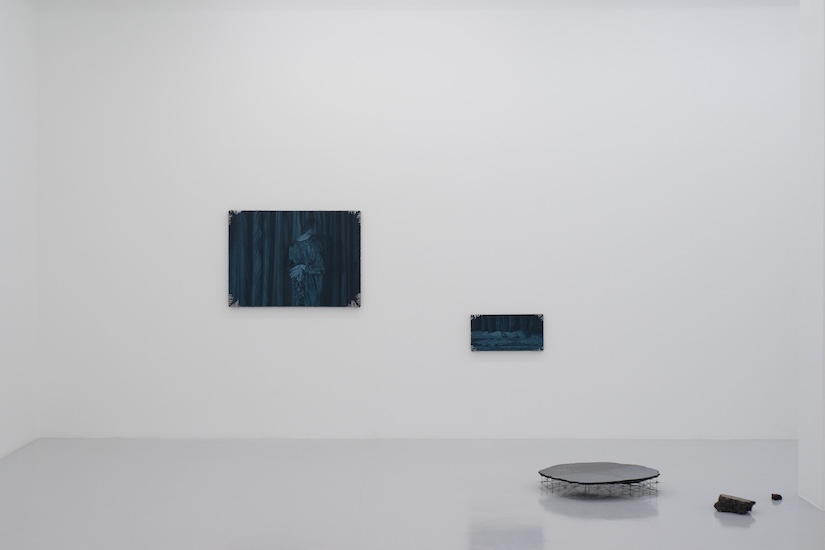
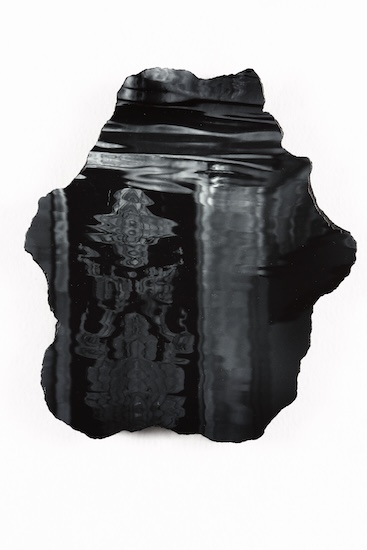
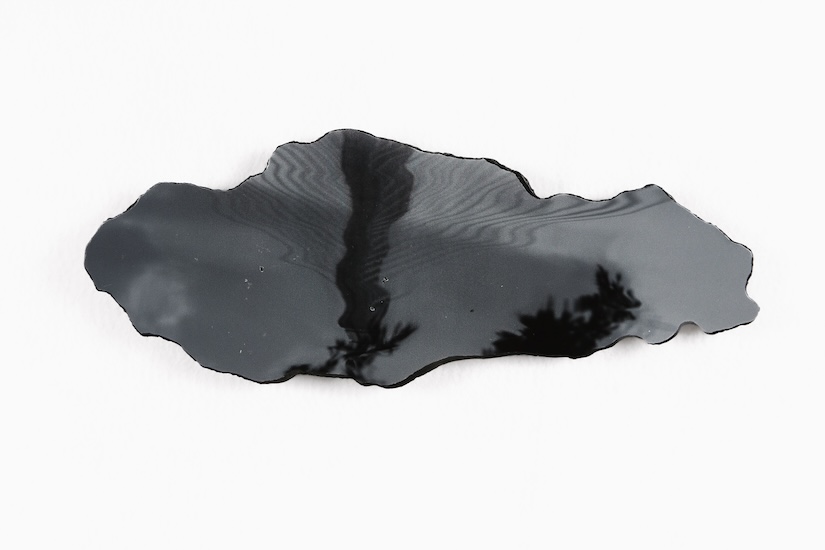
Interweaving and interrupting the gallery space are Tada Hengsapkul’s monochromatic prints on fragments of resin. Ghostly displays of Thailand’s urban architecture and constructions ripple and morph, the resin itself recalling asphalt, concrete, and scaffolding. Stemming from Hengsapkul’s personal experience of his journeys back to hometown in Nakhon Ratchasima, Northeast Thailand and the rough roads of Bangkok where he currently resides, his works conjure the artificial image of a decaying administrative structure. His road fragments such as The Tall Fence utilise casted potholes near his hometown, merged and overlaid with photographs of watery reflections of the grand architecture of Thai public buildings emulating a misty-eyed gaze growing ever weary.
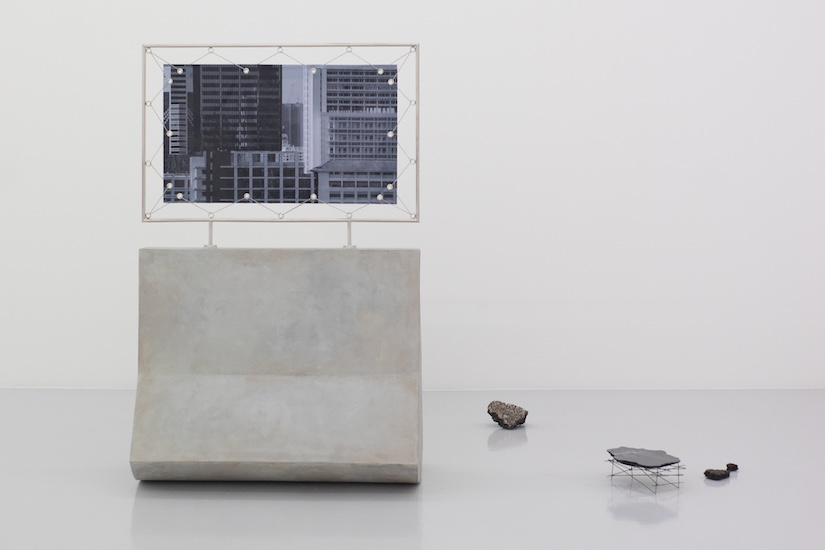
Economic Cycle is a barrier-like concrete sculpture rocking gently back-and-forth. Printed on tarp and mounted with metal wire is the image of dense high-rise condominiums and office-towers shot from the rooftops of Samyan Mitrtown Building in Bangkok. These towering buildings, symbols of progress and promise, appear elusive and adrift with unsteady foundations accentuated by the unbalanced movement of the sculpture. With a tone of irony and irreverence, Hengsapkul’s fractured road fragments and barricade become imitations of irrational movement, wavering and unsteady where they stand, highlighting the tension between decay and progress. Hengsapkul’s practice is often concerned with investigating and resisting various forms of control — at the level of the body, the collective, and society, through concerns specific to Thailand yet emblematic of much more widely shared questions and experiences.